 .
.

1868 – Arrival of the Religieuses Hospitalières de St-Joseph in Tracadie
St-Joseph Day School
Opening, on December 9, 1873, of the first free school in New Brunswick directed by a French female community. Fifty students registered. A storm door and an old borrowed table are the only furniture. Closure in December 1885.
St-Joseph Orphanage
In 1889, the nuns started taking under their care a few orphans and they started teaching them. They were lodged in rooms adjacent to the lazaret. September 3, 1898 marked the opening of a stone building which would serve as a hospital and accommodate the orphans on the third floor. In 1912, the orphans were transferred to the Académie Ste-Famille (Holy Family Academy).
Conditions of Admission to the Tracadie Orphanage1. Children must be at least 4 years old and no more than 12 years old. 2. They must not have any illness that would be detrimental to the orphans already admitted. 3. The child's parish priest's certificate and baptismal certificate must be presented. 4. Orphans are required to attend the various classes taught by the nuns. They learn to read, write, and do arithmetic according to their age and ability. 5. Although the institution is Catholic, children of other faiths are accepted if they comply with the orphanage's regulations. 6. The nuns reserve the right to return the child to the parents or guardian at any time and without being required to provide a reason. Parents are asked to leave sufficient funds with the orphanage to cover the child's return. If the father, mother, or guardian cannot be found, the sisters will try to place the child without causing them any concern. 7. Parents or guardians who entrust one or more children to the care of the nuns are asked to contribute what they can to support them, as the work is based on public charity. Once admitted, the children are fed, clothed, and receive the necessary health and medical care. 8. If wealthy individuals without children wish to adopt orphans and help them find a suitable place in society, the nuns will request the written consent of the parents or guardians. 9. The cost of board, bedding, and laundry, for those who can afford it, is $60 per year per orphan. 10. Anyone giving alms of 10 cents per year will be entered on the list of benefactors; if wealthy and charitable people wish to take sole responsibility for the maintenance and education of an orphan, the superior of the orphanage will make it known to her benefactors and vice versa, so that the child, when grown, can show his gratitude to those who protected him. |
Holy Family Academy (Académie Ste-Famille)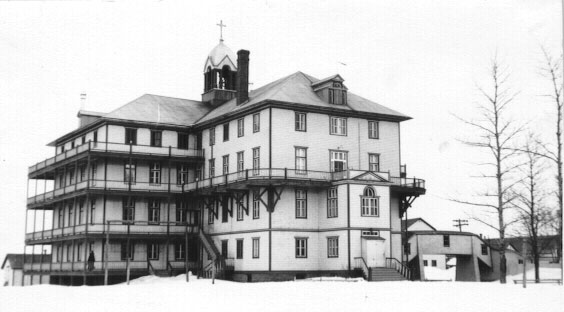
The spring of 1910 saw the beginning of the construction of the future Académie Ste-Famille, a dream come true for Mgr Barry and the nuns who wanted a school for the orphans, the village children and surrounding areas. The school opened on September 12, 1912 to 200 resident and day students. They were taught academic and commercial courses, home economics,singing, music and painting. It operated as a private school until 1967, welcoming more than 5000 resident students, not counting numerous day  students. From 1967 to 1976, it became a public school of the Department of Education.
Cours enseignés à l'Académie Sainte-Famille (1927-1966)
| Niveau et Année | Matières enseignées |
|---|---|
| Grade 5 and 6, 1929 | Catechism, French reading, English reading, Spelling, Daily Homework, Calligraphy, Drawing, French grammar, English Grammar, Arithmetic, Physiology, (Physics), Natural History, Geography, Canadian and English History. |
| Grade 7, 1951 | Christian Doctrine, French Grammar, English Grammar, Spelling, French Reading and Composition, Geography, Hygiene, Science, Arithmetic. |
| Grade 8, 1930 | Religious studies, French grammar, English grammar, English Literature, Geography, Natural History, Arithmetic, Drawing, Chemistry, Latin, Algebra, Geometry, French Reading, Daily Homework, Canadian and English history. |
| Grade 9, 1934 | Religious Studies, French Grammar, English Grammar, English Literature, History, Geography, Natural History, Arithmetic, Drawing, Chemistry, Latin, Algebra, Geometry, Home Economics. |
| Grade 10, 1932 | History of Religion, French, English Grammar, English Literature, World History, History of England and Canada, Botany, Geography, Arithmetic, Physiology (Physics), Drawing, Chemistry, Latin, Algebra, Geometry, Home Economics. |
| Grade 10, 1948 | Christian Doctrine, French Grammar, French Literature, English Grammar, English Literature, History, Latin, Algebra, Geometry, Physics, Chemistry. |
| Grade 11, 1927 | Catechism, French, English Grammar, English Literature, World History, English History, Botany, Geography, Arithmetic, Physiology (Physics), Drawing, Latin, Chemistry, Algebra. |
| Grade 11, 1949 | Christian Doctrine, French grammar, English grammar, French Literature, English Literature, History, Latin, Physics, Chemistry, Algebra, Geometry. |
| Grade 12, 1966 | Religion, French, English, French Composition, English Composition, Geometry, History, Chemistry, Biology. |
Marie-Berthe Drainville, known as Sister Fauteux
Marie-Berthe Drainville, known as Sister Fauteux was born on November 15, 1887, in Berthierville, Quebec. Her parents, Désiré Drainville, a physician, and Marie-Flore Fauteux, moved to Montreal when she was only six months old. One of 15 children, 11 of whom died in infancy, she was preceded in Tracadie by her sister, Marie-Anne. She entered the novitiate in Tracadie on July 28, 1913, and immediately began teaching music, becoming the organist the following year. She studied at the Saint-Léon Academy with the Sisters of the Congregation of Notre-Dame and held diplomas in shorthand, modern and Gregorian chant, violin, and piano teaching. From 1915 to 1917, she was an assistant to the music teacher and held this position until 1950. From 1920 to 1925, she also served as the headmistress of the boarding school for the older girls. Her activities were numerous, for in addition to teaching piano, harmonium, violin, mandolin, and guitar, and preparing students for concerts, she gave lessons in singing, solfège, diction, elocution, and etiquette, all while continuing her own musical studies and serving as the community organist. Alongside the courses associated with the core subjects, musical training became a steadily growing activity at the Academy.
To facilitate violin instruction, Sister Fauteux was sent to Montreal to pursue her musical studies and obtain her violin diplomas.
The graduation ceremony is the cultural event of the year in Tracadie, and the concert hall is always packed. The musical ensemble of the time includes up to 30 or 40 students who perform solo pieces, duets, or what is called the "orchestra."
One of the last remaining highly talented ensembles is composed of members of a family, the "Coughlan Orchestra," made up of the sons and daughters of John Coughlan and Elizabeth Robichaud. Each year, they also present a play.
In 1950, she was appointed organist at the Notre-Dame de Lourdes Sanatorium in Bathurst, and then, for eight years, at the Vallée-Lourdes novitiate. She was also a teacher of singing, diction, Gregorian chant, and organist for the novices. From 1959 to 1963, she served as organist at the Vallée-Lourdes Sanatorium The Coughlan Orchestra
before returning to the infirmary at the Hôtel-Dieu de Tracadie. She died on January 28, 1967.
Her work lives on through the performance hall that bears her name on the 3rd floor of the Académie Sainte-Famille.